
'We started affordable housing loans that has good traction and the books have grown to Rs 750 crore as of the end of last quarter.'

The Union finance ministry will meet CEOs of public sector banks to discuss issues related to cybersecurity in the wake of the Rs 820 crore (Rs 8.2 billion) fraud that hit Kolkata-based UCO Bank last month.

The new Samvat 2080 is viewed as a year of hope for industrial and precious metals. A key reason is the expectation of US interest rates peaking, followed by a reduction in the coming months. Regarding crude oil, its trajectory depends more on how the situation unfolds in West Asia.

Between March 2022 and September 2023, HDFC Bank added 56,310 employees.

'Pandemic has triggered interest and awareness among the people about the need for healthcare.'

'We are focused on playing on our strengths, which are technology, and building a large profitable business by working with banks as well as non-banks and NBFCs for loans.'

Sashidhar Jagdishan, managing director and chief executive officer of HDFC Bank, the largest private-sector lender of the country, has just completed his first term. The period October 2020-October 2023 was a roller coaster, and the second one, which started on October 27, could be more interesting as the lender absorbs the impact of the merger of HDFC, which was integrated on July 1, and moves to the next growth phase. Soon after he took over the reins from Aditya Puri on October 27, 2020, the Reserve Bank of India (RBI) debarred HDFC Bank from enrolling new credit card customers and launching new products under the Digital 2.0 programme due to repeated outages on its mobile-banking and internet-banking platforms.

In a move to strengthen governance in private sector banks and wholly-owned subsidiaries of foreign banks, the Reserve Bank of India (RBI) on Wednesday directed them to have at least two wholetime directors. Lenders that do not meet the requirement will have to submit the names for the RBI's approval within four months. Banks need prior approval from the banking regulator for the appointment of wholetime directors.

'Data-dependence means you can raise or drop rates. The present stance is only for raising rates.'
HDFC Bank has reshuffled the portfolios of its senior management team. This is the first major rejig after the amalgamation of HDFC Ltd on July 1. "The runway for our growth is large. This change is being done to bring in a very sharp focus on leveraging what we have built and for enhanced execution," said Sashidhar Jagdishan, managing director and chief executive of HDFC Bank, explaining the reason for this overhaul.

The currency in circulation (CIC) declined in the first half of this financial year and this is the first time this has happened in H1 in at least 10 years. The CIC on March 31, 2023, was Rs 33.78 trillion, which fell to Rs 33.01 trillion on September 22 -- a difference of about Rs 76,658 crore. In the first half of the last two financial years, the CIC went up by Rs 33,357 crore in FY23 and Rs 84,978 crore in FY22.

The sons learned that they had been completely disinherited and that Surinder Kanwar's new wife would inherit everything.
'At the policy's maturity, the total premium is refunded.'

'If through growth and serving the customer we become number one, we will be very happy and very proud.'

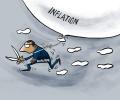
The spike in food prices at the onset of the monsoon season has corroborated the Reserve Bank of India's (RBI's) view that the fight against inflation is far from over, the State of the Economy report of the central bank said. At the same time, the report said that the country is poised to become the fastest-growing major economy in the world, notwithstanding some sequential moderation in economic activity in June. Consumer Price Index (CPI)-based inflation rate increased to 4.8 per cent in June 2023, from 4.3 per cent in May, primarily on account of an increase in food inflation.
'We created war rooms -- from an IT perspective and also a customer war room -- to address any challenges that come up.'

Only 21 tonnes of gold have been mobilised in the last eight years under the gold monetisation scheme (GMS) which was announced by the Government of India in November 2015. This could be considered as a failure as the scheme has undergone several changes with a revamped GMS announced in April 2021 to improve collections. This figure was released by the World Gold Council (WGC) on Wednesday in its report titled 'Gold Investment Market and Financialisation, in India gold market series'.

The Reserve Bank of India (RBI) has given HDFC Bank six months to migrate HDFC's home loan customers to external benchmark linked lending rate (EBLR), top sources in the bank told Business Standard. Almost half of HDFC's 5.4 million customers are home loan customers. It is mandatory for banks to link retail loans and loans to micro, medium and small enterprises to an external benchmark. Non-banking financial companies do not have such a mandate.
'If all goes well, we may well hit or even surpass the forecast growth rate.'

UCO Bank, Bank of Maharashtra, Bank of India, Indian Overseas Bank, Indian Bank, and Central Bank of India don't have a non-executive chairman.
 © 2026 Rediff.com - Advertise with us - Disclaimer - Privacy Policy - Sitemap - Feedback - About us - Terms of use - Grievances